What torture! How can I not touch the wall with all the ancient history and tactile chunks of flint! I didn't though, I kept to the rules!
Continuing our visit of Norwich, how could we not visit this
Cathedral. After all, I do love taking you around these don't I? So with mobile camera in hand, it's time to look at this ancient building.
Norwich Cathedral was begun in 1096, finishing in 1145 with the Norman spire. There have been some repairs obviously to the building over the centuries but nothing serious since 1480. What a testament to the craftmanship back then compared with now.
So, let's take a look inside. Entering the Cathedral, you come across this ancient medieval entrance. I love seeing old and new architecture together.
The interior of the Cathedral was incredible compared to the near plainness of the exterior. A tardis! Every corner you take there are more beautiful wonders to enjoy as well as being welcomed by very knowledgeable and friendly people.
The richness of colour coming through the stained glass windows still shone through seeing that outside it was so grey and raining.
The fifteenth century window above the West Gate was so vibrant and lit up the interior with warmth.
One thing I love about Cathedrals is to look through the arches to see how much I can see through just one opening. Here, the
organ plays a huge part, not just in sound but also in presence.
Looking towards the High Altar, the enormity of the building really shone through. The throne is the only one in Northern Europe that faces the congregation, they are usually to one side of the altar.
The treasury steps in the Cathedral restored my faith in old worn stairs after seeing the filled in Castle ones.
The Hanging Chrismatory was a very special sight. This contains the Holy Oils for annointing the sick and dying, another for baptism and another for after baptism, confirmation, ordination of priests and consecration of bishops. Usually these will be locked away but Norwich Cathedral have this suspended for all to see. A very unique and spiritual sight.
Just outside, a quiet courtyard and a well tended grave. Here is the last resting place for the infamous
Edith Cavell. Edith Cavell gave her life in World War I by saving the lives of many soldiers, not distinguishing between the sides. She was tortured and then shot for treason.
So, let's go and have a look at the Cloisters. These are one of the largest in England, only beaten by Salisbury Cathedral. They were designed to house 100 monks and are on two stories. Simply breathtaking.
And so our visit came to an end on this glorious building. Next, to walk out of the precincts and find our way to
Elm Hill (my next installment). Until then, look at the building across the way in the wonderfully named
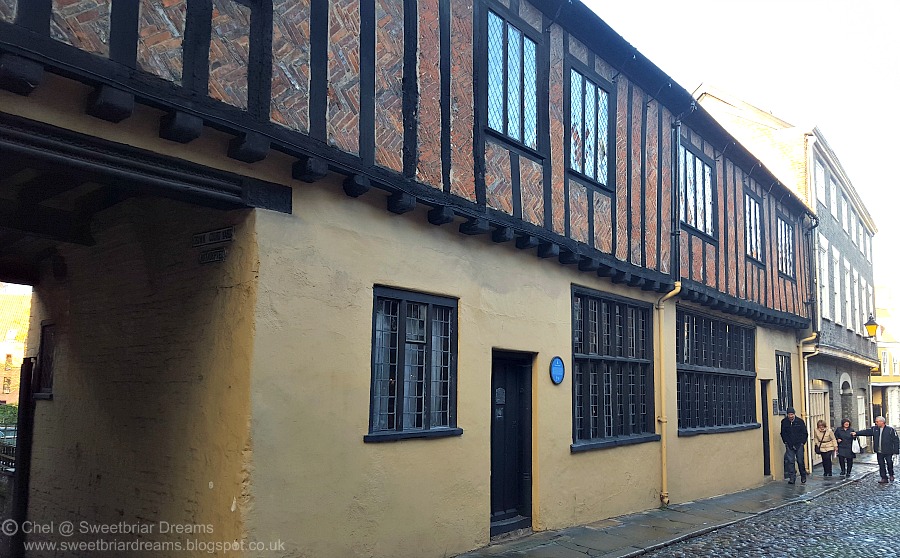
Tombland opposite to the Cathedral. A higglety pigglety house. I love these old Tudor buildings that look like they have blown in the wind. This, I think, is the old home of Augustine Steward who was a cloth merchant as well as Mayor three times.
So until then, thank you once again for your lovely comments on my last post. I am so pleased you are enjoying the trips out and about.